Oleh K. Romanchuk. Are territorial gains at Ukraine's expense possible, or developers-diplomats against US federal law?

On August 2, 2017, the official website of the Embassy of Ukraine in the United States announced that US President Donald Trump had signed a law strengthening sanctions against Russia.
"The US President Donald Trump signed into law the Countering America's Adversaries Through Sanctions Act, which significantly strengthens and expands sanctions against the Russian Federation and supports the sovereignty and territorial integrity of Ukraine.
In a separate statement, the US President noted that the United States would not tolerate interference in its democratic process and would continue to stand in solidarity with its international allies and friends to counter Russian subversive and destabilizing actions. <...>
The law defines the policy of the United States as follows: – supporting the Government of Ukraine in restoring its sovereignty and territorial integrity; – condemning and countering all destabilizing efforts of the Russian Federation government in Ukraine; – not recognizing the illegal annexation of Crimea by the Russian Federation government or the seizure of any part of Ukraine's territory by military force; – providing assistance in reforming Ukraine's energy sector and reducing dependence on Russian energy resources; – continuing to oppose the implementation of the Nord Stream 2 project.
The document also legislates existing sanctions against Russia; creates a mechanism for mandatory approval by the US Congress of any decision by the US President to ease anti-Russian sanctions; provides for the possibility of imposing sanctions against Russian state-owned enterprises operating in the metallurgical and mining industries and in rail transport; strengthens anti-Russian sectoral sanctions against the Russian financial sector and Russian energy sector; provides for the introduction of sanctions in connection with the activities of the Russian government aimed at undermining cyber security; targets individuals responsible for human rights violations in Russian-occupied territories, acting in the interests of the Russian government's defense and intelligence sectors, significantly contributing to Russia's ability to privatize state assets, as well as foreign individuals and entities that have contributed to strengthening the Syrian government's defense capabilities.
The law gives the US President the right, in coordination with US allies, to impose sanctions on individuals and legal entities that contribute to the development and maintenance of Russian export oil and gas pipelines.
This refers to the US federal law imposing additional sanctions on Iran, North Korea, and Russia – the Countering America's Adversaries Through Sanctions Act (CAATSA).
We emphasize once again: The law was signed by President Donald Trump on August 2, 2017, and has the status of public law (PUBLIC LAW 115–44 – AUG. 2, 2017). COUNTERING AMERICA’S ADVERSARIES THROUGH SANCTIONS ACT – https://congress.gov/115/plaws/publ44/PLAW-115publ44.pdf.
(PUBLIC LAW 115–44 – AUG. 2, 2017).
COUNTERING AMERICA’S ADVERSARIES THROUGH SANCTIONS ACT
https://congress.gov/115/plaws/publ44/PLAW-115publ44.pdf).
CAATSA creates significant legal constraints on US diplomatic negotiations regarding Ukrainian territories through several mechanisms enshrined in federal law.
Section 216 of CAATSA establishes a mechanism for mandatory congressional approval of any attempts to weaken or lift sanctions against Russia. The US president cannot lift sanctions on his own—this requires the consent of both houses of Congress, which makes the reversal process extremely difficult politically and legally.
Section 253 of the law institutionalizes the Stimson Doctrine (ex injuria jus non oritur), clearly stating that the US does not recognize territorial changes made by force, including the annexation of Crimea and the occupation of eastern Ukraine. This is not just a declaration—it is a legally binding policy that obliges all branches of the US government to adhere to this principle.
It is worth quoting at least a few excerpts from this document, which is extremely important for the Ukrainian state:
"<...> Subtitle B—Countering Russian Influence in Europe and Eurasia
SECTION 251. CONCLUSIONS.
Congress makes the following conclusions:
The Government of the Russian Federation has sought to exert influence throughout Europe and Eurasia, particularly in the former republics of the Soviet Union, by providing resources to political parties, think tanks, and civil society groups that sowed distrust in democratic institutions and actors, promoted xenophobic and illiberal views, and otherwise undermined European unity. <...>
SECTION 253. POLICY STATEMENT.
The United States, consistent with the principle of ex injuria jus non oritur, supports the policy known as the “Stimson Doctrine” and thus does not recognize territorial changes achieved by force, including the illegal invasions and occupations of Abkhazia, South Ossetia, Crimea, eastern Ukraine, and Transnistria. <…>
SECTION 257. ENERGY SECURITY OF UKRAINE.
(a) POLICY STATEMENT—It is the policy of the United States
States—
(1) to support the Government of Ukraine in restoring its sovereignty and territorial integrity;
(2) to condemn and oppose all destabilizing efforts by the Government of the Russian Federation in Ukraine in violation of its commitments and international agreements;
(3) never recognize the illegal annexation of Crimea by the Government of the Russian Federation or the separation of any part of Ukraine's territory through the use of military force;
(4) deter the Government of the Russian Federation from further destabilizing and invading Ukraine and other independent countries in Central and Eastern Europe <...>
(7) assist Ukraine and the United States' allies and partners in Europe in reducing their dependence on Russian energy resources, especially natural gas, which the Government of the Russian Federation uses as a weapon to coerce, intimidate, and influence other countries;
(8) cooperatw with European Union member states and European Union institutions to promote energy security through the development of diversified and liberalized energy markets that provide diversified sources, suppliers, and routes;
(9) continue to oppose the construction of the Nord Stream 2 pipeline, given its negative impact on the energy security of the European Union, the development of the gas market in Central and Eastern Europe, and energy reforms in Ukraine; <...>
(b) PLAN TO PROMOTE ENERGY SECURITY IN UKRAINE.–
(1) GENERAL PROVISIONS.–The Secretary of State, in coordination with the Administrator of the U.S. Agency for International Development and the Secretary of Energy, shall work with the Government of Ukraine to develop a plan to enhance energy security in Ukraine, increase energy production in Ukraine, and reduce Ukraine's dependence on energy imports from the Russian Federation. <...>
Section 257 specifies that it is the policy of the United States to support the sovereignty and territorial integrity of Ukraine and not to recognize any separation of part of Ukraine's territory through the use of military force. This creates a legal obstacle to any "compromise" solutions that would legitimize the Russian occupation.
Any agreement that would recognize Ukraine's loss of territory as a result of Russian aggression would require not only an executive decision by the president, but also a change in federal law through Congress. This is an extremely high barrier, as it requires a majority in both houses, and CAATSA was passed with overwhelming support (419-3 in the House of Representatives, 98-2 in the Se
The law also imposes automatic sanctions on individuals and companies that contribute to Russia's defense sector, cyberattacks, or human rights violations in the occupied territories. Any negotiations on a "freeze of the conflict" with recognition of Russian control would automatically contradict these provisions, as sanctions will remain in force as long as Russia controls Ukrainian territories by force.
We will not mention the current American developers of diplomacy and their political bosses.
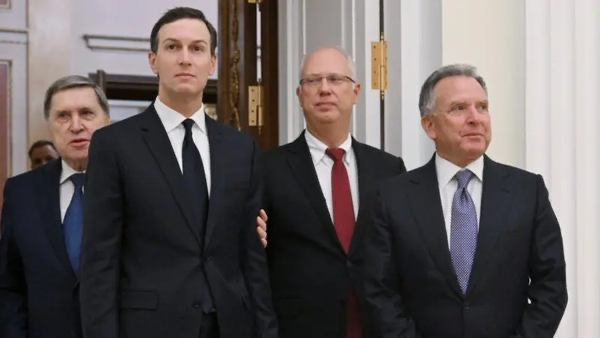
From left to right: Yuri Ushakov, Trump's son-in-law Jared Kushner, Kirill Dmitriev, and Steve Witkoff
This federal law remains in force and has the status of public law, which means it is binding on all branches of the US government. The law creates a mechanism for mandatory approval by Congress of any presidential decisions to ease sanctions against Russia. The provision on non-recognition of territorial changes made by force is a legally binding principle of US foreign policy, enshrined in law.
Are Ukrainian politicians and ambassadors really unfamiliar with this law, which prohibits the use/application of "backroom deals" in international negotiations?
Oleh
K. ROMANCHUK, PhD,
editor-in-Chief of the magazine "Universum"